There are no Conspiracy theories, there are only truth and lies. - Skizit Powers

What electronics are in a medical WBAN
ceiling/doorway mounted system in InfraGard store infrastructure, hospitals and other buildings to hit Targets?
These torture systems have been placed in the INFRASTRUCTURE of America. They are in Walmart, Publix, Winn-Dixie, Dollar Market, hospitals, post offices and other public buildings. They strike Targeted Individuals all over their bodies while they try to shop for food.
A Wireless Body Area Network (WBAN)—also known as a Body Area Network (BAN) or Medical Body Area Network (MBAN)—primarily involves low-power wireless sensors worn on or implanted in the body to monitor physiological signals (e.g., heart rate, ECG, temperature, motion) or activity. These body-worn nodes typically communicate in a star topology to a central coordinator or hub (sometimes called a sink or gateway node).
An "inhabitant location WBAN ceiling mounted system" refers to an indoor infrastructure setup for WBAN-based monitoring and localization/tracking of people (inhabitants or patients) within a building, such as a smart home, hospital, assisted-living facility, or research testbed. In these systems, WBAN sensors transmit data, and ceiling-mounted fixed nodes (or access points/coordinators) serve as infrastructure to receive data from on-body sensors, enable localization (e.g., via RSSI, time-of-arrival, or channel measurements) to track the person's position indoors and forward aggregated data to external networks (e.g., Wi-Fi, Ethernet, cloud). Ceiling mounting provides good line-of-sight coverage, reduces body-shadowing effects, and supports multi-room or whole-building tracking.
Typical Electronics in a Ceiling-Mounted WBAN Fixed Node/System
The ceiling-mounted unit acts as a fixed sink, coordinator, or access point (AP). It is usually more powerful than body nodes and includes these core electronics components (similar to other wireless sensor network infrastructure but optimized for WBAN frequencies, low interference, and indoor propagation):
Microcontroller or Processor Unit:
A low-to-mid-power MCU (e.g., ARM-based like STM32, or embedded Linux-capable boards in advanced setups) for data processing, protocol handling (e.g., IEEE 802.15.6, Zigbee, or custom MAC), localization algorithms, and network management.
Handles packet reception, timestamping for localization, and routing/aggregation.
Wireless Transceiver/Radio Module:
Supports WBAN-compatible standards or protocols (often 2.4 GHz ISM band, Ultra-Wideband (UWB) for better localization accuracy, or sometimes narrowband options).
Common tech: Bluetooth Low Energy (BLE), Zigbee/IEEE 802.15.4 derivatives, or proprietary low-power radios. Some advanced systems use multiple radios for diversity or hybrid communication.
Features multiple antennas or MIMO configurations in research prototypes for better coverage and fading mitigation in indoor environments.
Omnidirectional or ceiling-optimized antennas (e.g., patch, dipole, or array) mounted to provide downward coverage with minimal nulls.
Often designed for low SAR (Specific Absorption Rate) compliance and to handle body-induced channel variations. Ceiling placement helps achieve more stable propagation compared to body-worn setups.
Power Supply and Management:
Mains-powered (AC/DC converter) with battery backup or PoE (Power over Ethernet) in professional installations, since ceiling units don't have the severe power constraints of body sensors.
Voltage regulators, power management ICs (PMICs) for efficient operation.
Sensors (Optional, for Enhanced Functionality):
Environmental sensors (temperature, humidity) or motion/infrared sensors to correlate with inhabitant tracking.
In some smart-building integrations: acoustic, occupancy, or additional RF sensors for hybrid localization.
Interface and Connectivity Modules:
Wired backhaul: Ethernet, USB, or serial for connecting to a central server, cloud gateway, or building management system.
Sometimes Wi-Fi or LPWAN module for broader integration.
Memory (flash/RAM) for buffering data, especially during poor channel conditions or high-traffic scenarios.
Supporting Circuitry:
ADC/DAC if analog interfacing is needed.
Clock/timing modules for precise synchronization (important for localization).
Enclosure with mounting hardware (e.g., flush or pendant ceiling mount), shielding for EMI, and thermal management.
In research or experimental setups (e.g., hospital wards or testbeds), a fixed ceiling node might be configured with higher transmit power (e.g., 18 dBm) compared to body nodes to ensure reliable uplink from moving inhabitants.
Key Considerations for These Systems
Localization Role: The ceiling unit(s) often use signal metrics (RSSI, phase, or time-based) from body transmissions to estimate position without relying solely on GPS (which fails indoors). Multiple ceiling nodes can enable triangulation or fingerprinting.
Power and Range: Ceiling units prioritize reliable coverage over ultra-low power. Body nodes are the constrained ones (energy harvesting).
Standards: IEEE 802.15.6 is the dedicated WBAN standard; many implementations adapt 802.15.4 or BLE.
Challenges Addressed by Ceiling Mount: Reduces body shadowing, improves channel stability, and supports "extra-WBAN" links to infrastructure.
Exact components vary by implementation (commercial medical systems vs. research prototypes vs. smart-home IoT). Commercial products may integrate into broader platforms (e.g., with Wi-Fi APs), while academic setups often use off-the-shelf modules like Zigbee boards or custom PCBs.
What equipment is stalled in infrastructure to carry out Targeted strikes?
In a hospital designed to communicate with a person’s Wireless Body Area Network (WBAN) sensors or tracking implants are governed by strict regulations (e.g., IEEE 802.15.6, FCC medical bands, HIPAA-like privacy rules). The same system would be illegal in a grocery store because direct store-to-implant communication raises enormous privacy, security, safety, and ethical concerns; however, stores such as, but not limited to Publix, Winn-Dixie, Aldi’s, Walmart and Dollar Store use it today.[1] They are all InfraGard partners and work with the FBI to carry out these vicious attacks. They all have this equipment and use it to strike Targeted persons in their implants to cause them to eliminate in public or to have the most excruciating pain where their implants are. We ask that an authority for the State of Florida investigate the equipment they have and the fact that they do this. The equipment may be in the building plans. Any Targeted person can tell you that they are being assaulted when they shop for food. Targets are being tagged like slaves or animals and shocked or burned for no reason at all.
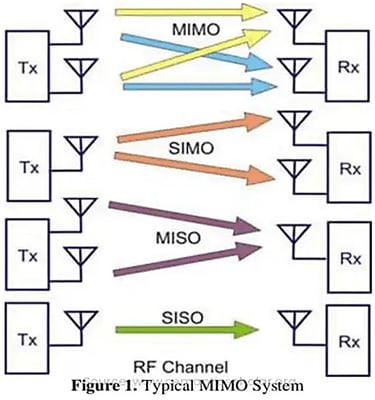
Such a system relies on a dedicated infrastructure network of fixed WBAN coordinators/gateways (ceiling- or wall-mounted for optimal coverage in aisles, open areas and over doorways). These would act like specialized access points (APs) that receive data from (and send limited commands to) implanted sensors. Cell-free massive MIMO or distributed MIMO for WBANs, which use multiple antennas and cooperating APs to overcome body shadowing, movement, and multi-user interference in dynamic indoor spaces like a store.
What the Store Would Have: Core Electronics in the Fixed Infrastructure Nodes
These nodes would be distributed throughout the store (ceiling grids, shelf tops, or entrance/exit points) and form a star or mesh topology with body sensors. They differ from standard Wi-Fi APs by being optimized for ultra-low-power, short-range, medical-grade WBAN protocols and implant constraints (e.g., very low transmit power to meet Specific Absorption Rate/SAR limits).
MIMO-Capable Wireless Transceiver/Radio Module
Multi-antenna (e.g., 4–8+ elements per node, or distributed across nodes in cell-free setups) radio supporting WBAN frequencies.
Common bands: 2.4 GHz ISM (for wearables), Medical Implant Communications Service (MICS) band (402–405 MHz) or its modern equivalents for true implants, or Ultra-Wideband (UWB 3–10 GHz) for high-precision data + localization.
MIMO features: beamforming, spatial diversity, and interference cancellation to maintain reliable links while shoppers move through aisles. In cell-free massive MIMO designs, dozens of distributed APs cooperate via backhaul to serve all nearby body sensors simultaneously with fair, high-quality links.
Protocols: IEEE 802.15.6 (WBAN standard), BLE derivatives, or proprietary low-power modes. Implants often use inductive or far-field RF with strict power limits.
Microcontroller/Processor Unit + Memory
Mid-range embedded processor (e.g., ARM-based) for real-time packet handling, synchronization, basic localization (RSSI, time-of-arrival, or channel state info), and multi-user scheduling.
Buffering memory to aggregate data from many customers before forwarding to the store’s backend.
Antennas and RF Front-End
Ceiling-optimized antennas (patch arrays or omnidirectional) mounted downward for broad, low-null coverage. MIMO arrays reduce fading caused by human bodies and store shelving.
Shielding and tuning for indoor multipath and regulatory compliance (medical safety, no interference with other store systems).
Power Supply and Management
Mains-powered via Power over Ethernet (PoE) or direct AC/DC — no battery constraints like body nodes. Includes backup and efficient PMICs.
Backhaul and Network Interface
Wired (Ethernet) or wireless (store Wi-Fi/5G small-cell) connection to a central server or cloud for data processing (e.g., anonymized analytics, personalized offers — though this is speculative and highly privacy-sensitive).
Optional environmental sensors (motion, temperature) for context-aware operation.
Supporting Circuitry
Precise timing/clock modules (for localization or synchronized MIMO).
Security hardware (encryption accelerators, secure boot) — critical for medical-grade data.
Enclosure: vandal-resistant, aesthetically discreet ceiling or recessed mounts (similar to commercial Wi-Fi APs but with WBAN-specific RF transparency).
How Communication Would Work (Hypothetically)
Body sensors/implants → transmit physiological or ID data periodically (very low duty cycle to save power).
Store nodes → listen continuously, use MIMO techniques to capture weak signals despite movement, crowds, or body orientation.
Data is aggregated locally or sent to a store backend. In research cell-free MIMO WBAN setups, this provides better coverage and fairness than a single coordinator (like a phone).
In practice today, stores use equipment that interface directly with medical WBAN implants or sensors. This very real illegal deployment is being done with the permission of the United States government because the DOJ oversees the FBI and InfraGard partners in stalking, harassing and torturing Targeted persons. They have covered their crimes with lies claiming the persons experiencing the shocking, burning and torture are delusional or have mental problems. That is the oldest trick in the book and it is still working to cover these crimes.
[1] Su H, Zhao Z, Gu B, Lin S. Power Control in Wireless Body Area Networks: A Review of Mechanisms, Challenges, and Future Directions. Sensors (Basel). 2026 Jan 23;26(3):765. doi: 10.3390/s26030765. PMID: 41682280; PMCID: PMC12900006.
What does a MIMO system look like?
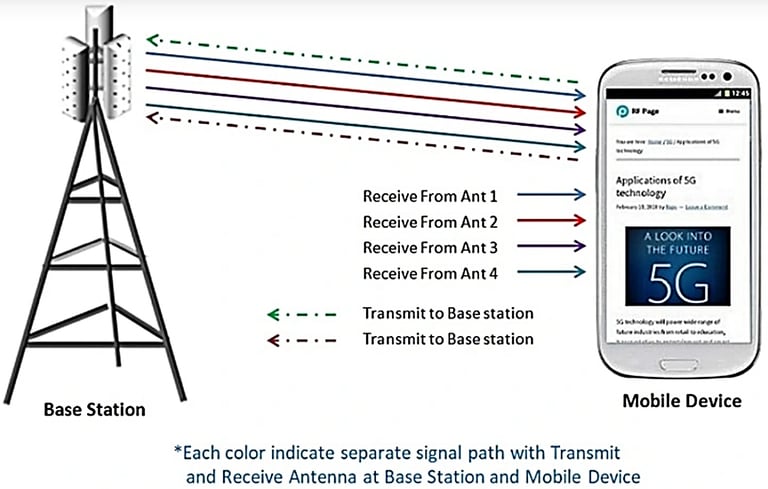
A MIMO (Multiple-Input, Multiple-Output) system looks like a wireless device—such as a 5G base station, router, or smartphone—equipped with multiple distinct antenna elements (2×2, 4×4 or massive arrays) designed to transmit and receive multiple data streams simultaneously on the same frequency. Physically, these appear as crowded antenna panels, often using slant-polarized elements (±45∘) to boost data rates and signal reliability.
Visual and Physical Characteristics:
Antenna Array: Rather than one antenna, a MIMO system features arrays of 2,4,8 or dozens/hundreds (Massive MIMO) of antenna elements. [There are an endless number of locations in space where one beam crosses another to locate you.]
Compact Design: These elements are tightly packed, often in vertical or cross-polarized arrangements to create separate spatial paths.
Base Station Appearance: 5G/LTE tower antennas appear as rectangular panels, while Wi-Fi routers feature multiple external antennas (dipoles) or hidden arrays inside.
Smartphone/Device: Devices use small, diverse, and often hidden internal antennas, sometimes placed at opposite ends of the phone to maximize spatial diversity.
How it Works (Beamforming):
Data Streams: MIMO systems do not just use more antennas to boost power; they create separate, independent data paths (spatial multiplexing) to multiply data rates.
Beam Steering: Advanced, or "Massive MIMO," systems in 5G use these antenna arrays to create shapeable, steerable beams, focusing signals directly at specific user devices rather than broadcasting in all directions.
MIMO Configurations:
2×2 MIMO: Two antennas at each end (common in basic Wi-Fi 5).
4×4 MIMO: Four antennas (common in 4G LTE/Wi-Fi 6).
Massive MIMO: >8×8, commonly used in 5G, with hundreds of elements on one panel to serve many users simultaneously.
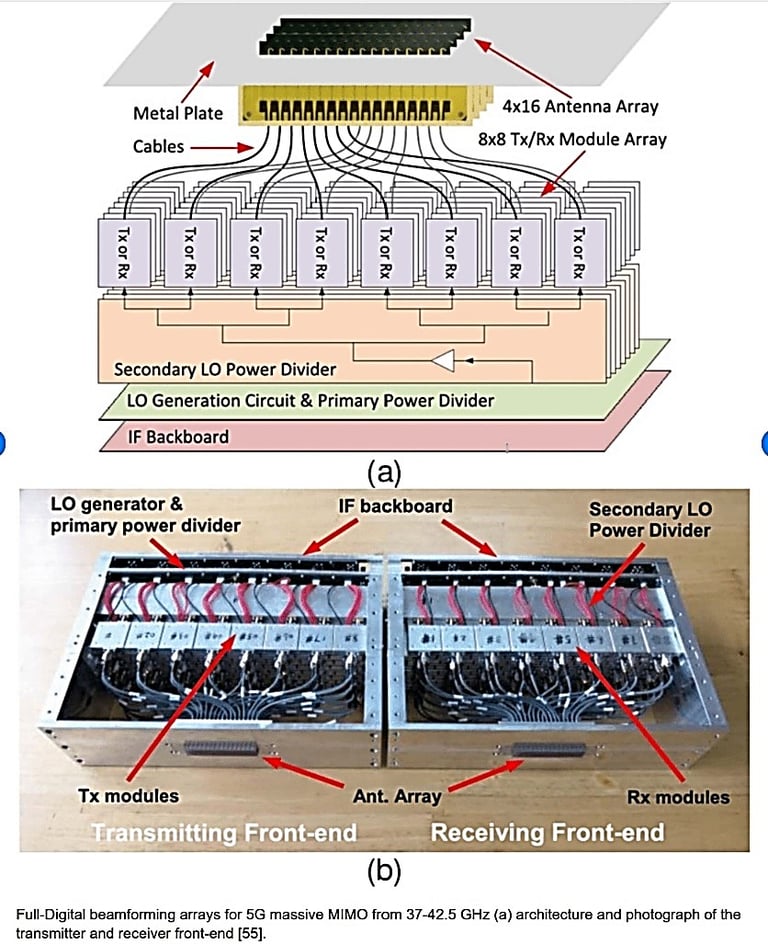
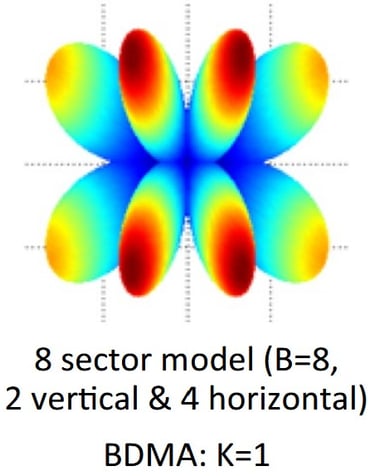
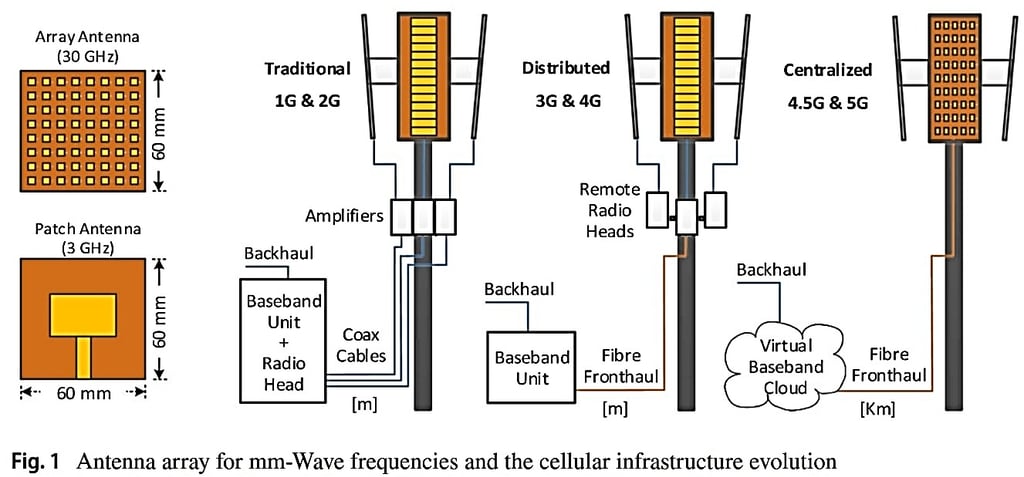
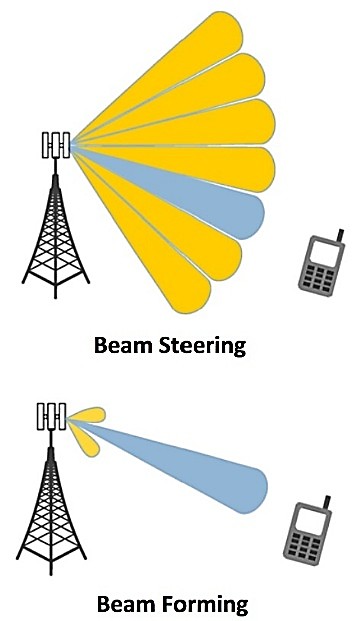
Massive MIMO Systems for 5G Communications
https://link.springer.com/article/10.1007/s11277-021-08550-9
Antenna Technologies for 6G – Advances and Challenges
Driven by emerging applications such as extended reality (XR), holographic communications, and dynamic digital twins (DT) as well as the development of artificial intelligence and high performance computing, wireless communications technologies are experiencing unprecedented rapid growth.
Whilst the fifth generation (5G) networks, especially 5G mm-wave systems are still being rolled out, the international standardization body for mobile communications, the Third Generation Partnership Project (3GPP), has already released 3GPP Release 18, known as 5G-Advanced [1], [2], [3]. 5G-Advanced serves as a critical foundation towards future sixth generation (6G) mobile communications networks under the framework of IMT-2030.
Technological evolution from 5G to 6G systems is poised to deliver several key capabilities and features, which is illustrated in Fig. 1, where the key performance indicators of IMT-2030 (6G) and IMT-2020 (5G) are compared, and several of them have significant implications for antenna technologies [4], [5].
First, the expected growth of augmented reality (AR) and virtual reality (VR) as well as dynamic digital twins renders it necessary for future wireless networks to move up to higher frequency bands as well as to embrace massive multi-input-multi-output (MIMO) to achieve enhanced mobile broadband (eMBB) with unprecedented data rates of up to 1 Tbp/s.
Although higher bands are not favorable for large area coverage, they are necessary to deliver the data rates required for certain 6G applications. The massive MIMO concept was first introduced to 5G wireless networks in 3GPP Release 15.
By implementing beamforming and spatial multiplexing using antenna arrays with hundreds or even thousands of elements, the system can achieve significant improvement in terms of coverage expansion, increased throughput, and higher signal quality. Moving into 6G, the mobile communications networks are expected to achieve massive MIMO with an even greater number of antenna elements. However, as shown in the current roll-out of 5G, supporting massive MIMO whilst maintaining reasonable base station costs is a significant challenge.
Second, integrated sensing and communications (ISAC), which is a variant of joint communications and sensing, is widely regarded as one of the hallmark features of 6G [6], [7]. By exploiting the signatures and changes of radio signals going through the environment, ISAC makes the traditional communications-only network dual-functional, serving as a distributed sensing network whilst supporting connectivity.
Y. Jay Guo, Fellow, IEEE, Charles A. Guo, Student Member, IEEE, Ming Li, Member, IEEE, and Matti Latva-aho, Fellow, IEEE (Invited Paper)Antenna Technologies for 6G
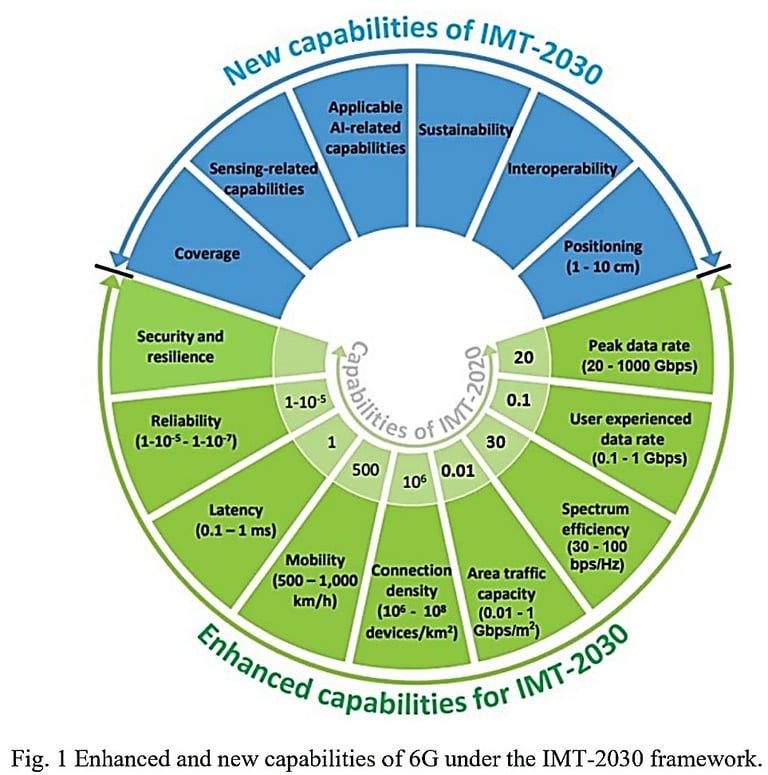
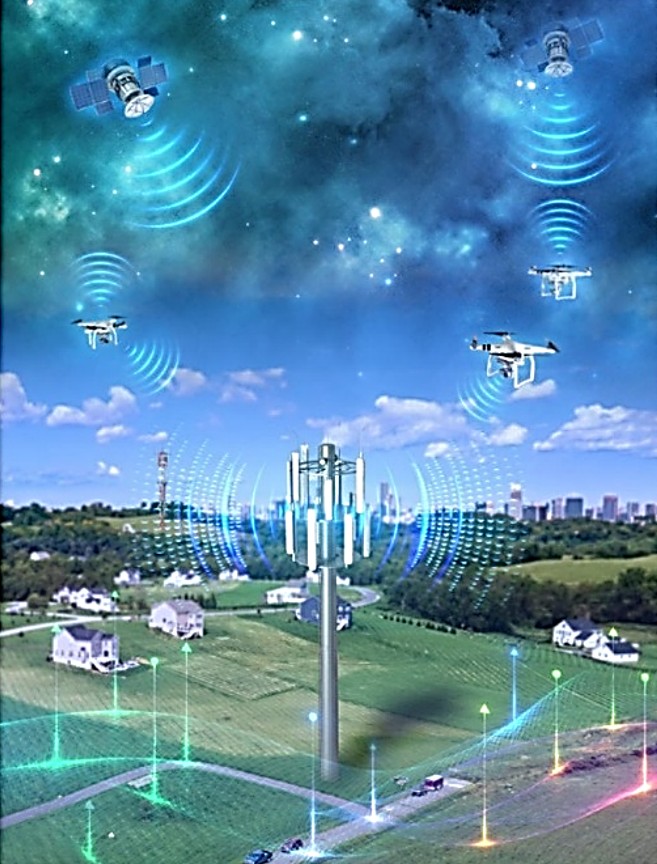
Fig. 2. Base stations supporting UAVs, LEO satellites and users on the ground.
Terahertz Beam Steering: from Fundamentals to Applications
https://link.springer.com/article/10.1007/s10762-022-00902-1
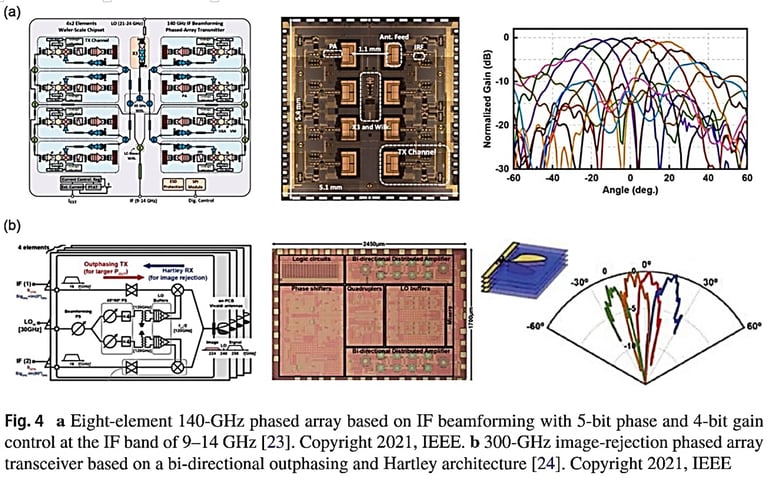
What is a MAC address?
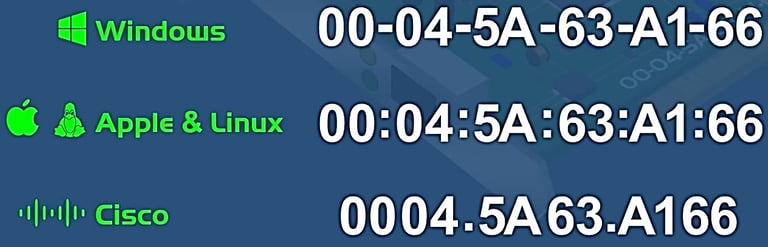
A MAC (Media Access Control) address is a unique, hardware-based identifier (like a serial number) assigned to a device's network adapter (NIC) for communication on a local network, functioning as its physical "address" within that segment, ensuring data goes to the right device using a 12-digit hex code (e.g., 00:1A:2B:3C:4D:5E). It operates at the data link layer of the OSI model, allowing devices to find each other and communicate locally, unlike IP addresses which are for broader network routing.
"3. Existing/Proposed MAC Protocols for WBANs
3.1. IEEE 802.15.4
IEEE 802.15.4 is a low-power protocol designed for low data rate applications. It offers three operational frequency bands: 868 MHz, 915 MHz, and 2.4 GHz bands. There are 27 sub-channels allocated in IEEE 802.15.4, i.e., 16 sub-channels in 2.4 GHz band, 10 sub-channels in 915 MHz band and one sub-channel in the 868 MHz band, as given in Table 2. The table also shows the data rate and the modulation technique for each frequency band. IEEE 802.15.4 has two operational modes: a beacon-enabled mode and a non-beacon enabled mode. In a beacon-enabled mode, the network is controlled by a coordinator, which regularly transmits beacons for device synchronization and association control."
https://pmc.ncbi.nlm.nih.gov/articles/PMC3270832/pdf/sensors-10-00128.pdf


Where do they monitor you from?
A clinical monitoring hub is a centralized, technology-driven system—often utilizing Remote Patient Monitoring (RPM)—that collects and analyzes patient data (vitals, glucose, ECG) in real-time, allowing healthcare providers to track health metrics from home or hospital settings. These hubs improve patient outcomes, reduce readmissions, and facilitate proactive care.
Key components and functions of clinical monitoring hubs include:
Real-time Data Integration: Solutions like Signant Health's Clinical Data Hub ingest and standardize data from multiple sources.
Remote Patient Monitoring (RPM): Companies such as HealthSnap and Accuhealth offer cellular-enabled devices (blood pressure monitors, glucose meters) that automatically transmit data to providers.
Clinical Analytics and Alerts: Systems use algorithms to monitor patient data for abnormalities, allowing for early intervention before emergencies arise.
Digital Workflow Optimization: Solutions like Roche's navify Clinical Hub optimize workflows and connect all aspects of care.
Clinical Trial Support: Programs from Frederick National Laboratory and PPD support the strategic monitoring of global clinical trials, including decentralized and remote monitoring strategies.
This means you can find the clinical monitoring hub monitoring you!
Where are they monitoring you from?
Join us in advocating against
the misuse of technology.
Email: TargetedHumans@proton.me
© 2025. All rights reserved.


Targeted Humans Inc.