There are no Conspiracy theories, there are only truth and lies. - Skizit Powers
Articles on the Wireless Body Area Network
Nano-Enriched Self-Powered Wireless Body Area Network for Sustainable Health Monitoring Services
Abstract: Advances in nanotechnology have enabled the creation of novel materials with specific electrical and physical characteristics. This leads to a significant development in the industry of electronics that can be applied in various fields. In this paper, we propose a fabrication of nanotechnology-based materials that can be used to design stretchy piezoelectric nanofibers for energy harvesting to power connected bio-nanosensors in a Wireless Body Area Network (WBAN). The bio-nanosensors are powered based on harvested energy from mechanical movements of the body, specifically the arms, joints, and heartbeats. A suite of these nano-enriched bio-nanosensors can be used to form microgrids for a self-powered wireless body area network (SpWBAN), which can be used in various sustainable health monitoring services. A system model for an SpWBAN with an energy harvesting-based medium access control protocol is presented and analyzed based on fabricated nanofibers with specific characteristics. The simulation results show that the SpWBAN outperforms and has a longer lifetime than contemporary WBAN system designs without self-powering capability.
https://pmc.ncbi.nlm.nih.gov/articles/PMC10006880/pdf/sensors-23-02633.pdf
Technological Requirements and Challenges in Wireless Body Area Networks for Health Monitoring: A Comprehensive Survey
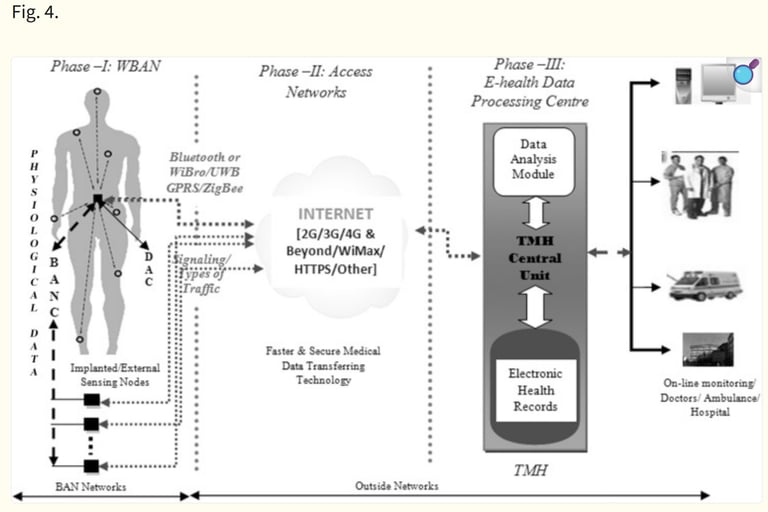
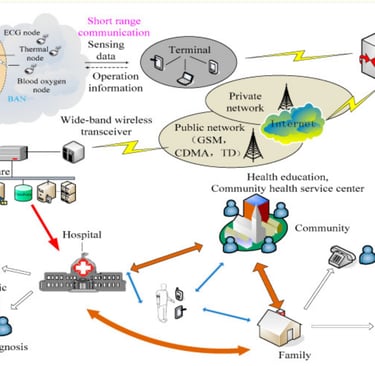
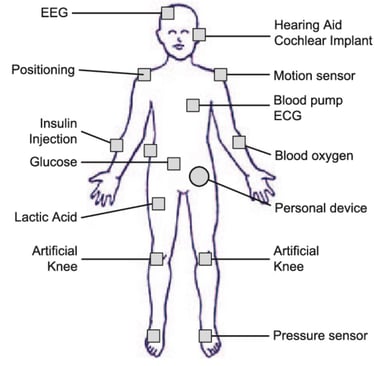
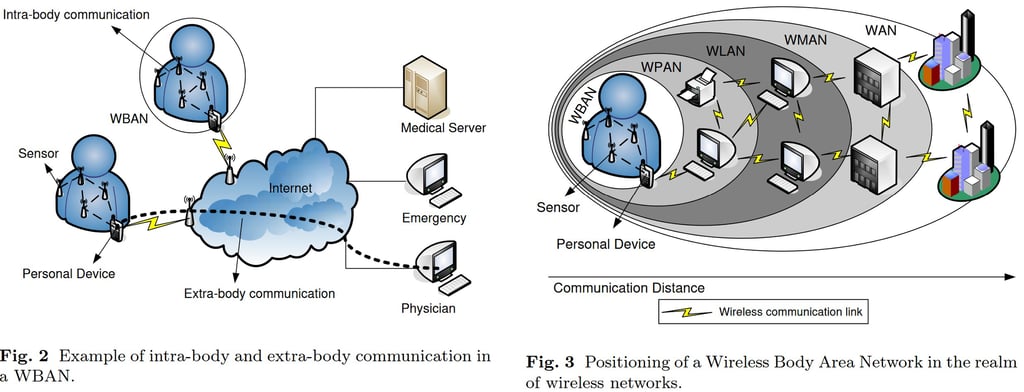
Due to the current developments in sensors and wireless communication technology, wireless body area networks (WBANs) may alleviate or even solve the problems of rampant chronic diseases, an aging population, a shortage of medical facilities, etc. A WBAN is a body network that enables communication between people and things by connecting nodes with sensors in, on or around humans [10]. Data transmission between these nodes is limited to an ultra-short distance of 2 m by wireless means. Figure 1 illustrates the basic idea of the WBAN and its applications. The responsibility of each node is to collect physiological parameters, such as electrocardiogram (ECG), electroencephalogram (EEG), blood oxygen saturation (SpO2), blood pressure (BP) and heart rate variability (HRV). The terminal plays a role of a personal server to gather all the data from nodes and then transmit them to the Internet. Moreover, WBAN system can provide bio-feedback to the patients from the remote servers. The servers on the remote system cannot only process the data efficiently, but also provide some services, such as real-time monitoring and health consultation, which is helpful for the management of chronic diseases. As shown in Figure 1, WBAN has a huge market, from which equipment manufacturers, operators, solution providers and service providers can all take a profit. That is another important reason why WBANs attracted great attention around the world as soon as the idea emerged. Taking advantage of WBAN technology is important for economic development as a new growth engine. Although WBANs are attractive for many applications, they are still in their infancy, and this new wireless technology combines multiple disciplines, such as communication, bio-engineering and microelectronics, making it difficult to solve the key issues.https://pmc.ncbi.nlm.nih.gov/articles/PMC9105253/
Predictive Data Mining for Converged Internet of Things: A Mobile Health Perspective
James Jin Kang, Sasan Adibi, Henry Larkin, Tom Luan
School of Information Technology
Deakin University, Burwood Australia
{jkang, sasan.adibi, henry.larkin, tom.luan}@deakin.edu.au
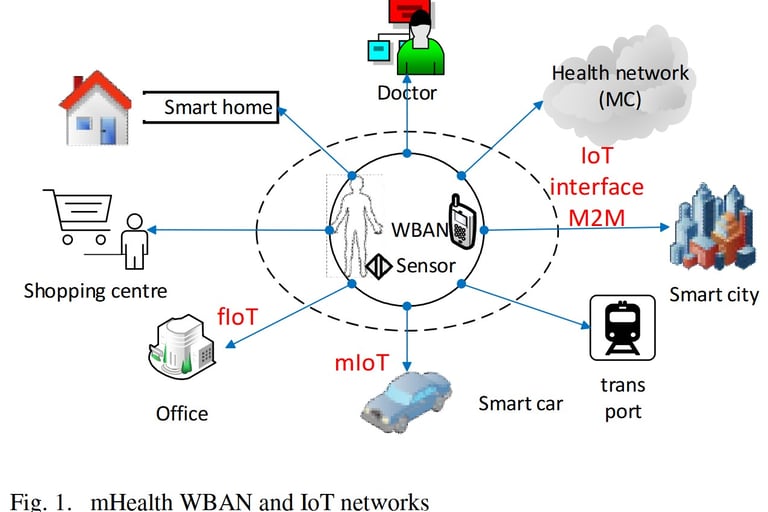
Internet and smartphone technology is evolving so fast that the demand for mobility and contactless technology is now prevailing more than ever. Wireless communication between devices is one example around the human body such as wireless headsets, wearable devices and wireless charging for smartphones. This enables additional demands for health related application software (apps) that monitor, collect and transmit health data to physicians for further analysis. This is called mHealth as a branch of electronic health (eHealth) [1], which is prevalent due to the broadband network deployed to support up to Gigabit Internet speeds [2]. Sophisticated technologies such as Cloud which provides a virtual data centre, infrastructure, platform and software as a service [3]. Big data and IoT are now being converged with mHealth of which data can be requested by health service providers and smart ‘things’. This data is to provide intelligent services such as smart light bulbs, smart TVs, smart homes, smart cars, smart cities and smart highways. Based on the health information received from Wireless Body Area Network (WBAN), those ‘things’ can provide efficient and effective service for humans by communicating between ‘things’ through machine to machine (M2M) interface. The European Telecommunications Standards Institute (ETSI) released a set of specifications [4] for a common M2M service platform as well as proposals with an open source project providing an autonomic ETSI-compliant M2M service platform [5]. This will eventually require the collecting of large volumes of data (big data) to analyze, process and create valuable information for humans and things. This process happens on a virtual space (e.g. Cloud) as well as a local WBAN domain.
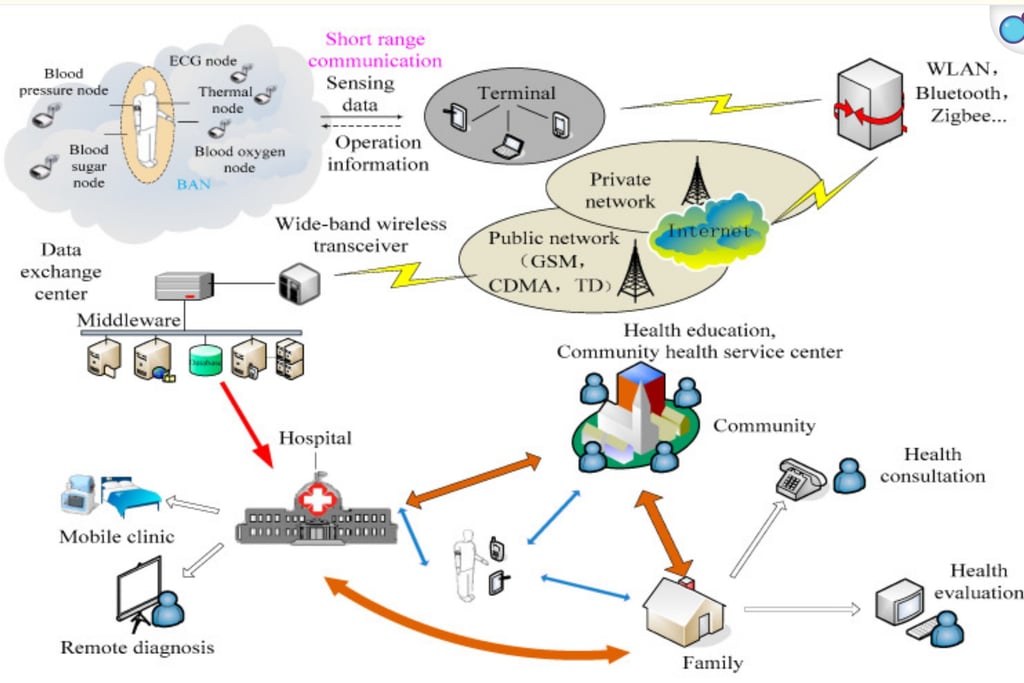
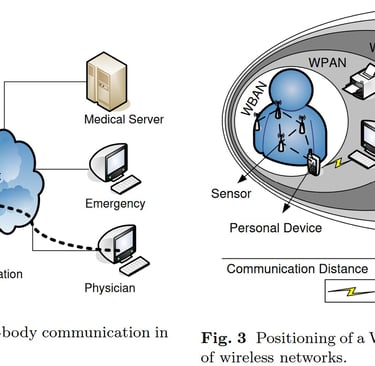
Fig.1 shows an example of mHealth WBAN that connects to smart environments through IoT interfaces which require health information from the user. As the first point of data collection, sensor devices such as wearables will play a key role to collect, process and analyze data. They will also decide when and what to transmit to the next hop (e.g. smartphone or IoT device/agent). In terms of data mining using big data in a Monitoring Centre (MC) to create meaningful information, most information so far has been created as a ‘descriptive’, which reports on past information. However, this is too slow for physicians to contact and treat a patient who needs urgent assistance. Cases such as heart attacks will require the data to be received and analyzed immediately or before it occurs (using previously received data) to be treated effectively. Therefore, analytics are required of ‘predictive’ data, which uses models of past data to predict the future, and ‘prescriptive’ data, which (is a purpose of this proposal) uses inference models to provide optimal actions based on the analyzed outcome [6]. For example, a physician should be able to warn their patients of predicted symptoms before it happens. mHealth networks must provide real-time information intelligently inferred to the physician and the patient. To do this, sensor devices need to be smart enough to interwork with smartphones and MC through data inference systems, which will require more computation capacity than typical sensors. Sensor devices are now improving significantly to make this happen. For example, wearable devices such as theApple Watch and Samsung Gear can provide multiple sensor functionalities such as a gyroscope, pedometer, accelerometer, heart rate, barometer and compass. They have powerful processors, memory (512MB) and storage (4G) to be smart [7].
When the database of Knowledge Base and big data has matured enough, it is possible to build up personal life expectancy, which is a new idea and outcome of a personal health status proposed by this paper. Current technology used tocalculate life expectancy is based on information such as race, people groups, nationality, geographical areas and diseases however, it cannot provide an individual life expectancy. mHealth converged with big data will be able to use an inference system to predict the life expectancy on a personal level as well as health status. There have been some attempts and research to calculate life prediction with algorithms [8-12], which focused on attributes and environment without doing on a personal and 2015 International Telecommunication Networks and Applications Conference individual level. With the convergence of mHealth and big data technology, it is possible to develop an individual life expectancy using personal health status being updated in real-time as well as short and long term prediction of the health status of mHealth users.
A survey on wireless body area networks
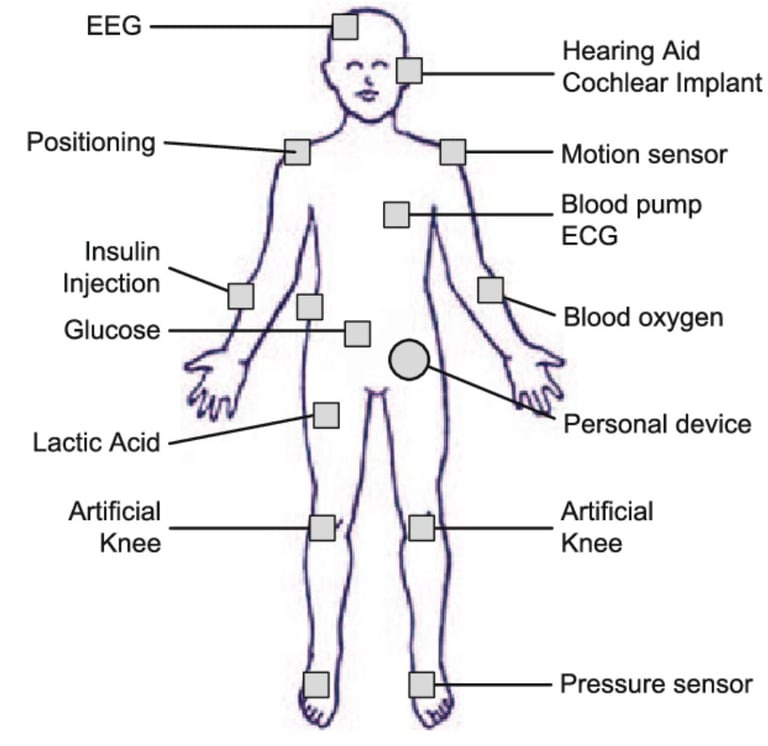
Generally speaking, two types of devices can be distinguished: sensors and actuators. The sensors are used to measure certain parameters of the human body, either externally or internally. Examples include measuring the heartbeat, body temperature or recording a prolonged electrocardiogram (ECG). The actuators (or actors) on the other hand take some specific actions according to the data they receive from the sensors or through interaction with the user. E.g., an actuator equipped with a built-in reservoir and pump administers the correct dose of insulin to give to diabetics based on the glucose level measurements. Interaction with the user or other persons is usually handled by a personal device, e.g. a PDA or a smart phone which acts as a sink for data of the wireless devices.
https://www.academia.edu/112656016/A_survey_on_wireless_body_area_networks?email_work_card=title
Join us in advocating against
the misuse of technology.
Email: TargetedHumans@proton.me
© 2025. All rights reserved.

Targeted Humans Inc.