There are no Conspiracy theories, there are only truth and lies. - Skizit Powers
Weapons: Raytheon's Ravens Claw
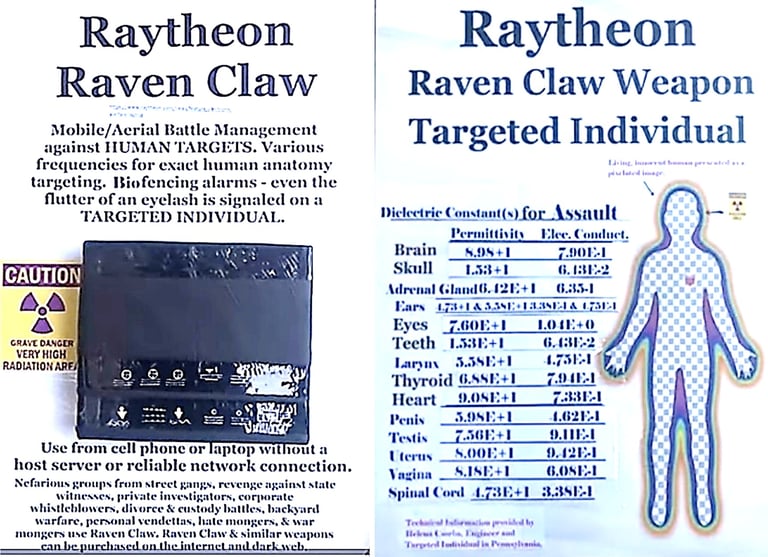

The understanding of the Raytheon Ravens Claw above does not match the description of the device exactly by the research. It is a software that is used with a yagi antenna to add about 10 - 20 db of signal strength to an existing signal and a piece of equipment like a laptop computer or mobile device.
You would not want to rule it out as a piece of equipment used to target people remotely as that is what is done on the battlefield. If it could show you a map of a battlefield, it could show you a map of a person's apartment and possibly show you where that person is at any given moment and the shape of the microwave tent on them.
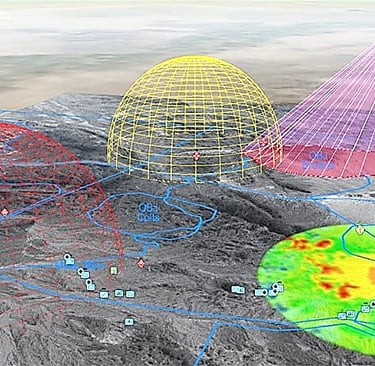
The Ravens Claw is not the actual weapon because it would need a horn or a waveguide to direct microwave on a small scale. The actual weapon would be in the area surrounding the Target, like in a next door apartment or in the ceiling or walls. They could set up a plan to have a tent of microwave like the illustration below and remotely carry it out. It manages directed energy weapons on a large terrain remotely so it is possible it could manage weapons and gangstalkers on a suburban battlefield. It looks like a tool which can be repurposed for stalking.
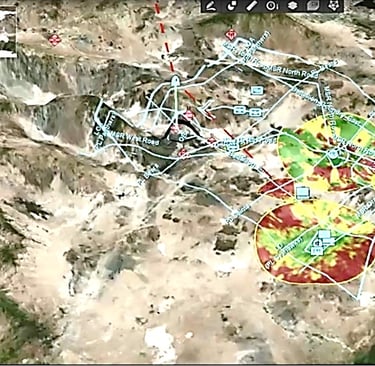
The description in the video of being targeted could be planned and operated from a distance. There are devices which can be aimed at a person so that microwaves target a human being or send an acoustic signal towards them. The picture below on the left shows the Raven Claw being used in the field. The picture on the right is like what the device would produce. The is a picture from an earlier device than the more recent Electronic Warfare Planning and Management Tool (EWPMT) so it is probably from the Ravens Claw (not certain).
U.S. Army in Final Stages of Developing EW Software Tool for Battle Management, By Frank Wolfe | October 30, 2019
Raytheon has delivered CD1 and CD2, and is working on CD3, targeted toward employment in a tactical environment against threats. CD3 includes the functionality of Raytheon’s Raven Claw, a mobile version of EWPMT that helps operators control signals in the field, “even without a host server or reliable connection to external data,” according to Raytheon. “Under the CD4 contract, Raytheon will continue to develop software and the user interface for a more connected, mobile system.” Over the next two years under a multi-million dollar contract with the Army, Raytheon is developing EWPMT Capability Drop 4 (CD4)–the last stage before the scheduled full operational capability, Increment 1–in 2021.
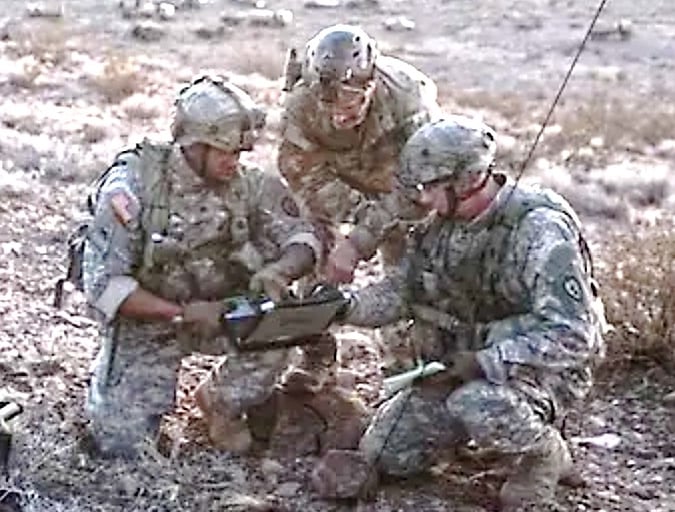
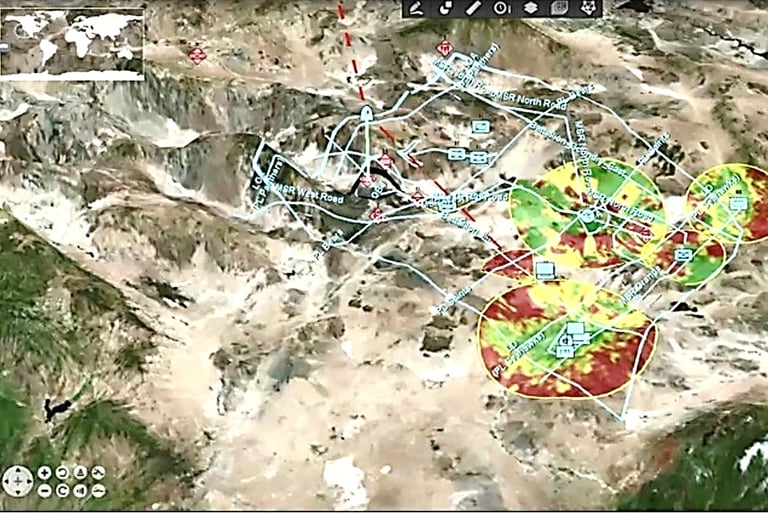
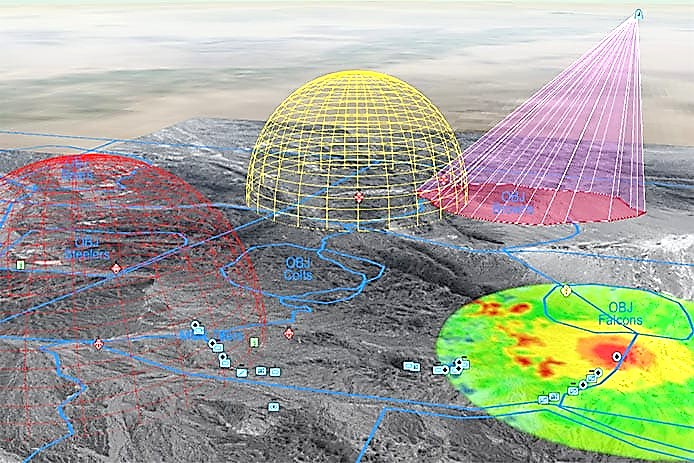
Raytheon’s Raven Claw (sometimes stylized as Ravenclaw) is a mobile, laptop-based electronic warfare (EW) controller designed for the U.S. Army to plan, manage, and control sensors and jamming systems in the electromagnetic spectrum. It is a variant of the broader Electronic Warfare Planning and Management Tool (EWPMT).
Key details about Raven Claw include:
Functionality: It enables operators to manage signals, analyze intelligence, and execute cyber/electronic attacks against hostile emitters, even without a connection to a host server or external data.
Development & Deployment: Developed in roughly six months, it was tested and subsequently deployed to the European theater to meet immediate operational requirements.
Rapid Delivery: Instead of waiting for the full EWPMT program (Increment 1), the Army used Raven Claw to fill immediate gaps, with capabilities from Raven Claw (1 & 2) being integrated into the larger EWPMT Capability Drop (CD3/CD4) development.
Capabilities: It consists of a laptop and antenna system designed to control multiple sensors from a single, shared interface.
Raven Claw allows for faster, more adaptive, and highly mobile electronic warfare capabilities compared to traditional, fixed, or larger-scale systems.
Visualizing The Invisible Battle: Raytheon’s EWPMT
With the new Raytheon software, the Army will no longer be fighting blind against enemy radio jamming — but its own jammers to strike back remain years away.
By Sydney J. Freedberg Jr. on October 03, 2019 5:06 pm
https://breakingdefense.com/2019/10/managing-the-invisible-battle-raytheons-ewpmt/
ARLINGTON: After five years of development — and urgent fielding of partial versions to troops in Europe and elsewhere — Raytheon just got the contract to complete the command-and-control software for the Army’s rapidly expanding electronic warfare corps, EWPMT.
The Electronic Warfare Planning & Management Tool is designed to get emissions, analyze them and make attack recommendations. How? It scrapes data from sensors across the battlefield, synthesizes it all into an intelligible map of where signals are getting through and where they’re being jammed, and simulates the effects of potential countermeasures so commanders can make an informed decision on how to counter the enemy. Over the next two years, Raytheon will receive an unspecified “multi-million dollar” sum to develop and field what’s called Capability Drop 4, upgrading the EWPMT software to its official Fully Operational Capability (FOC) by October 2021.
Soldiers using the Electronic Warfare Planning & Management Tool (EWPMT) in the field
Capability Drop 1 was the initial basic version for Army electronic warfare officers, Raytheon exec Niraj Srivastava told reporters this morning at a company briefing ahead of the annual AUSA mega-conference. CD 2 added spectrum-management functions to help deconflict friendly transmissions and keep US forces from accidentally jamming each other (which happens a lot). CD 3, now fielded with select units in Europe and other locations the Army won’t disclose, adds the capability to take in data from sensors in real-time, plus much more automation and analytics. (An early, slimmed-down version of CD was deployed under the codename Raven Claw).
What’s next? “With the fourth capability drop, we are bringing a lot more automation and machine learning/AI” to translate raw system data into a real-time picture of signal strength and interference across the battlefield, Srivastava said.
They’re also upgrading the software to work with a wider range of third-party sensors. “We just finished an exercise last month where we had about a dozen different industry partner sensors, from UAVs to terrestrial vehicles to man-mounted systems,” he said. Those sensors can either be plugged directly into the computer running the EWPMT software — which means that data is displayed, for all practical purposes, instantly — or connect over a wireless network — which allows the user to access many more sensors over a much wider area at the potential price of lag and interference.
EWMPT is an obscure piece of Army modernization compared to robot tanks and high-powered rifles. (You really know an Army program has been overlooked by the top brass when its acronym doesn’t spell out anything cool or pronounceable). But it’s a critical element of modern conflict. Russia in particular has used its mastery of electronic warfare to great effect against Ukraine, leading GPS astray with false signals, targeting Ukrainian troops for artillery barrages by tracking their radios and cellphones, and baffling US sensors in Syria.
Electronic warfare may be invisible to the human eye but the Army has sensors that can detect these transmissions. Doing something with that information has historically been a laborious process involving Excel spreadsheets, PowerPoint slides, and lots of yellow sticky notes. That leaves precious little time to actually think about what to do and make a plan.
EWPMT is intended to automate the process, giving electronic warfare troops a clear picture of what’s happening and what they can do about it. The heart of the software is a physics model that uses data from multiple sources to calculate how radio waves are interacting, or could interact, both with each other and the terrain. (Hills and buildings often block transmissions).
Army Tactical Electronic Warfare System (TEWS) at the National Training Center on Fort Irwin, California.
That model doesn’t care where its inputs come from or where its outputs go, Srivastava explained. So, using what’s called open architecture, it’s relatively straightforward to add a new software module to take in data from a new sensor, he said, or to alter how the data is displayed on the screen for different missions and users, or to transfer that data to other military systems.
For example, once EWPMT has figured out where jamming is coming from, it can share that location with the Army’s artillery fire control software, AFATDS, allowing the nearest howitzer battery to blow the enemy transmitter up. So the US Army will be able to do what Russia has been doing against Ukraine.
EWPMT will also be able to pass data to the Army’s own long-range offensive jammers, so they can disrupt hostile transmissions that can’t or shouldn’t be physically destroyed. The problem is most units won’t actually get those jammers for years to come.
The Army has a handful of prototype and experimental systems for offensive electronic warfare, many mounted on Humvees, MRAP trucks, or 8×8 Stryker armored vehicles. But the official Programs Of Record, the equipment that will actually be mass-produced and issued across the Army, won’t begin fielding until 2022-2023. Those would be the land-based Terrestrial Layer System (TLS) — formerly Terrestrial Layer Intelligence System because it includes SIGINT capabilities — and the drone-mounted Multi-Function Electronic Warfare – Air (MFEW-Air).
EWPMT Capability Drop 4 will have the capability to connect with both these systems, Srivastava said, but they won’t be in service until some time after it enters service in 2020-2021.
Raytheon's Raven Claw is a software-defined, tactical Electronic Warfare (EW) tool designed for battle management, specifically designed to visualize and manage the electromagnetic spectrum, rather than serving as a, high-power microwave weapon itself. While it operates within the microwave spectrum—as many electronic devices do—it is primarily an antenna and battle management application used for signal intelligence (SIGINT) and to manage electronic warfare operations.
Key Details regarding Raven Claw:
Purpose: It acts as an augmentation for the Electronic Warfare Planning and Management Tool (EWPMT).
Capabilities: As an antenna and management tool, it can add signal gain, but it is not described as a high-power microwave projector.
Distinction from HPM Weapons: While Raytheon develops high-power microwave (HPM) systems designed to disrupt electronics, the Raven Claw is categorized as a planning and management, system for electronic warfare, not a weaponized emitter.
Contextual Information:
Electronic Warfare Scope: Future battlefield conflicts are expected to be decided in the electromagnetic spectrum, with EW systems working to manage and control these signals.
Join us in advocating against
the misuse of technology.
Email: TargetedHumans@proton.me
© 2025. All rights reserved.


Targeted Humans Inc.