There are no Conspiracy theories, there are only truth and lies. - Skizit Powers
COMMUNITY ORIENTED POLICING FUNDING
Community Oriented Policing Services (COPS) Program
Updated May 9, 2024 (IF10922)
Background
Under the initial authorization for the Community Oriented Policing Services (COPS) program (Title I of the Violent Crime Control and Law Enforcement Act of 1994, P.L. 103-322, "the 1994 Crime Act"), grants could be awarded for (1) hiring new police officers or rehiring police officers who have been laid off to engage in community policing, (2) hiring former members of the armed services to serve as law enforcement officers engaged in community policing, and (3) supporting community policing nonhiring initiatives, such as training law enforcement officers in crime prevention and community policing techniques or developing technologies that support crime prevention strategies.
The COPS program was reauthorized by the Violence Against Women and Department of Justice Reauthorization Act of 2005 (P.L. 109-162). The act changed the COPS program from a multi-grant program to a single-grant program under which DOJ can make grants to state, local, and tribal governments, and other public and private entities for a variety of enumerated purposes (see 34 U.S.C. §10381(b)).
Congress has continued to appropriate funding for the COPS program even though authorized appropriations for the program expired in FY2009.
COPS Funding
From FY1995 to FY1999, the annual appropriation for the COPS program averaged nearly $1.4 billion. The relatively high levels of funding during this time period, compared to post-FY2000 appropriations, were largely the result of efforts to place 100,000 new law enforcement officers on the streets.
After the initial push to hire and fund 100,000 new law enforcement officers, Congress started to change the COPS program into a conduit for supporting a wider range of local law enforcement needs. Starting in FY1998, an increasing portion of the annual appropriation for COPS was dedicated to programs that helped law enforcement agencies purchase new equipment, combat methamphetamine production, upgrade criminal history record systems, and improve their forensic science capabilities. Increasing funding for nonhiring initiatives under the COPS account coincided with decreasing funding for hiring programs. By FY2005, appropriations for hiring programs were nearly nonexistent, and Congress eliminated funding for them for FY2006 and FY2007. Funding for hiring programs was revived when the American Recovery and Reinvestment Act of 2009 (P.L. 111-5) provided $1 billion for the COPS program. Appropriations for hiring programs from FY2009 to FY2012 were the result of Congress's efforts to help local law enforcement agencies facing budget cuts as a result of the recession either hire new law enforcement officers or retain officers they would otherwise have to lay off. Appropriations continued to be provided for hiring programs even as the effects of that recession waned.
There was a notable reduction in the total amount of funding provided for the COPS program after FY2012 relative to previous fiscal years. Prior to FY2012, the least amount of annual funding (in nominal dollars) provided for the COPS program was $472 million for FY2006. Although COPS program funding has increased over the past several fiscal years (Table 1), annual funding from FY2012 to FY2021 remained significantly lower than it was before FY2012. Lower annual appropriations for the COPS program during these fiscal years can be attributed to three trends: (1) a decrease in the amount of funding provided for hiring programs, (2) a ban on congressionally directed spending, and (3) Congress's restructuring of the COPS account. However, increases in annual COPS funding starting in FY2022 are attributable to a partial reversal of some of these trends.
Congress had a ban on congressionally directed spending from FY2011 to FY2021. This ban substantially decreased funding for the Law Enforcement Technology and the Methamphetamine Clean-up programs, which were being administered by the COPS Office. By FY2012, Congress did not appropriate any funding for the Law Enforcement Technology program and the only funding remaining for the Methamphetamine Clean-up program was transferred to the Drug Enforcement Administration to assist with the cleanup of clandestine methamphetamine laboratories. Congress ceased providing funding for the Methamphetamine Clean-up program in FY2018.
From FY2010 to FY2012, Congress moved appropriations for several programs that were funded under the COPS account—such as Project Safe Neighborhoods, DNA backlog reduction initiatives, Paul Coverdell grants, offender reentry programs, the National Criminal History Improvement program, and the Bulletproof Vest Grant program—to the State and Local Law Enforcement Assistance (S&LLEA) account. Programs funded under this account are administered by the Office of Justice Programs (OJP). Prior to the programs being moved to the S&LLEA, appropriations for them were transferred from the COPS Office to OJP for administration. In general, from FY2001 to FY2011, appropriations for programs that were transferred to OJP accounted for one-third to one-half of the annual funding for the COPS account. In recent fiscal years, differing proportions of the COPS account has again been transferred to OJP. Since FY2017, Congress has provided funding for the Regional Information Sharing System (RISS) program under the COPS account, which is transferred to OJP.
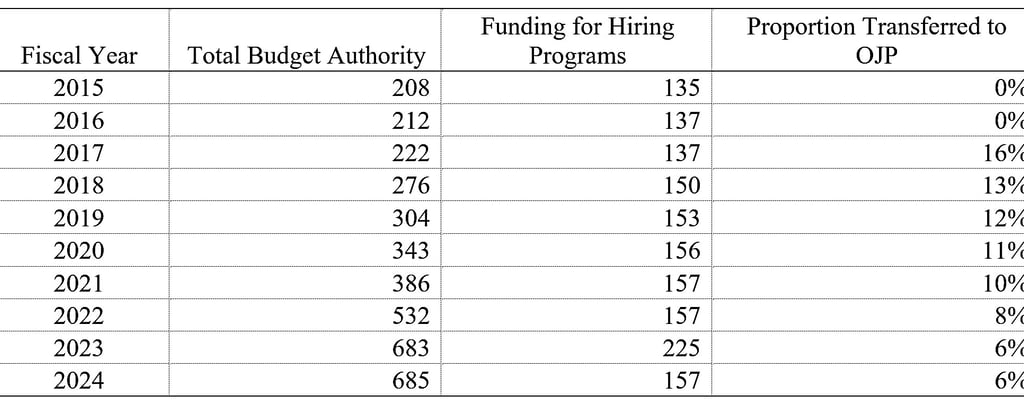
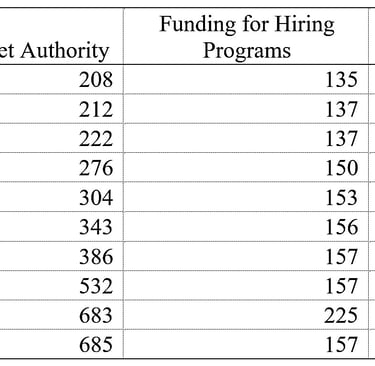
Funding for the COPS program has increased in the last seven fiscal years, from $208 million for FY2015 to $685 million for FY2024. Increased funding for the COPS account is the result of Congress increasing funding for hiring programs, and for nonhiring initiatives such as anti-heroin task forces, active shooter training, and grants under the Matching Grant Program for School Security. Also, for FY2024 Congress provided funding for the COPS Law Enforcement Technology program for the third straight fiscal year, after eliminating the program in FY2010.
Table 1. COPS's Total Budget Authority, Funding for Hiring Programs, and Transfers to OJP, FY2015-FY2024
Amounts in millions of nominal dollars
Sources: FY2015-FY2017 appropriations were provided by the U.S. Department of Justice, Office of Community Oriented Policing Services; FY2018-FY2024 appropriations were taken from the explanatory statement to accompany the annual Commerce, Justice, Science, and Related Agencies Appropriations Act.
Note: Total budget authority includes carryover from previous fiscal years.
Debate over the COPS Program, Law Enforcement Reform, and Violent Crime
Recently, funding for the COPS program, especially the hiring program, has become a flashpoint in the debate over policing reform. Some proponents of law enforcement reform argue that law enforcement agencies police communities of color in a biased way, and absent efforts to address underlying social factors, more police officers means that more people of color, especially Black men, will be subject to biased policing. Proponents of reform argue that funding should be used for programs that address social problems (e.g., poverty, homelessness, lack of access to mental health care) in order to reduce involvement with the criminal justice system rather than increasing the number of police officers.
President Biden has indicated his support for the COPS program as a way to promote law enforcement reform through community policing efforts. In his plan for criminal justice reform, President Biden stated
policing works best when officers are out of their cruisers and walking the streets, engaging with and getting to know members of their communities. But in order to do that, police departments need resources to hire a sufficient number of officers.… However, the [COPS] program has never been funded to fulfill the original vision for community policing.… As a condition of the grant, hiring of police officers must mirror the racial diversity of the community they serve.
Since FY2021, funding has been provided under the COPS account for programs to promote policing reform efforts, such as funding for de-escalation training, improving law enforcement's response to people with mental health problems, helping law enforcement agencies gain accreditation, and anti-bias and diversity training. While there was also continued funding for the COPS hiring program, for FY2024 the COPS Office gave additional consideration to applicants that indicated they would use funding to (1) recruit officers from the communities in which they would serve, (2) recruit officers who are willing to relocate to areas characterized by fragmented relations between police and community residents or to areas of high crime, and (3) require officers to complete evidence-based cultural sensitivity training.
The COPS program has also been integral to the debate over what steps Congress can take to aid state and local governments in their efforts to address violent crime. While there is debate over whether additional police officers alone can help reduce violent crime (see CRS In Focus IF12022, State and Local Law Enforcement Officer Staffing for a brief discussion), some policymakers have argued for additional funds for the COPS hiring program as one avenue to help cities address increases in violent crime. In its FY2025 congressional budget submission for the COPS program, the Biden Administration requested increased funding for the COPS hiring program to support the hiring of 2,000 additional officers and to "increase the capacity of law enforcement agencies to implement community policing strategies that strengthen partnerships for safer communities and enhance law enforcement's capacity to prevent, solve, and control crime – especially violent crime – through funding for additional officer and deputy positions." Some proponents of policing reform efforts argue that (1) policymakers have emphasized the need to increase the number of law enforcement officers as a means of tackling violent crime when they have not taken sufficient steps to address how the police treat people of color and (2) the focus on recent increases in violent crime in certain U.S. cities is detracting from efforts to follow through on law enforcement reform proposals.
Join us in advocating against
the misuse of technology.
Email: TargetedHumans@proton.me
© 2025. All rights reserved.
Targeted Humans Inc.